
Hello. This is a post about lines.
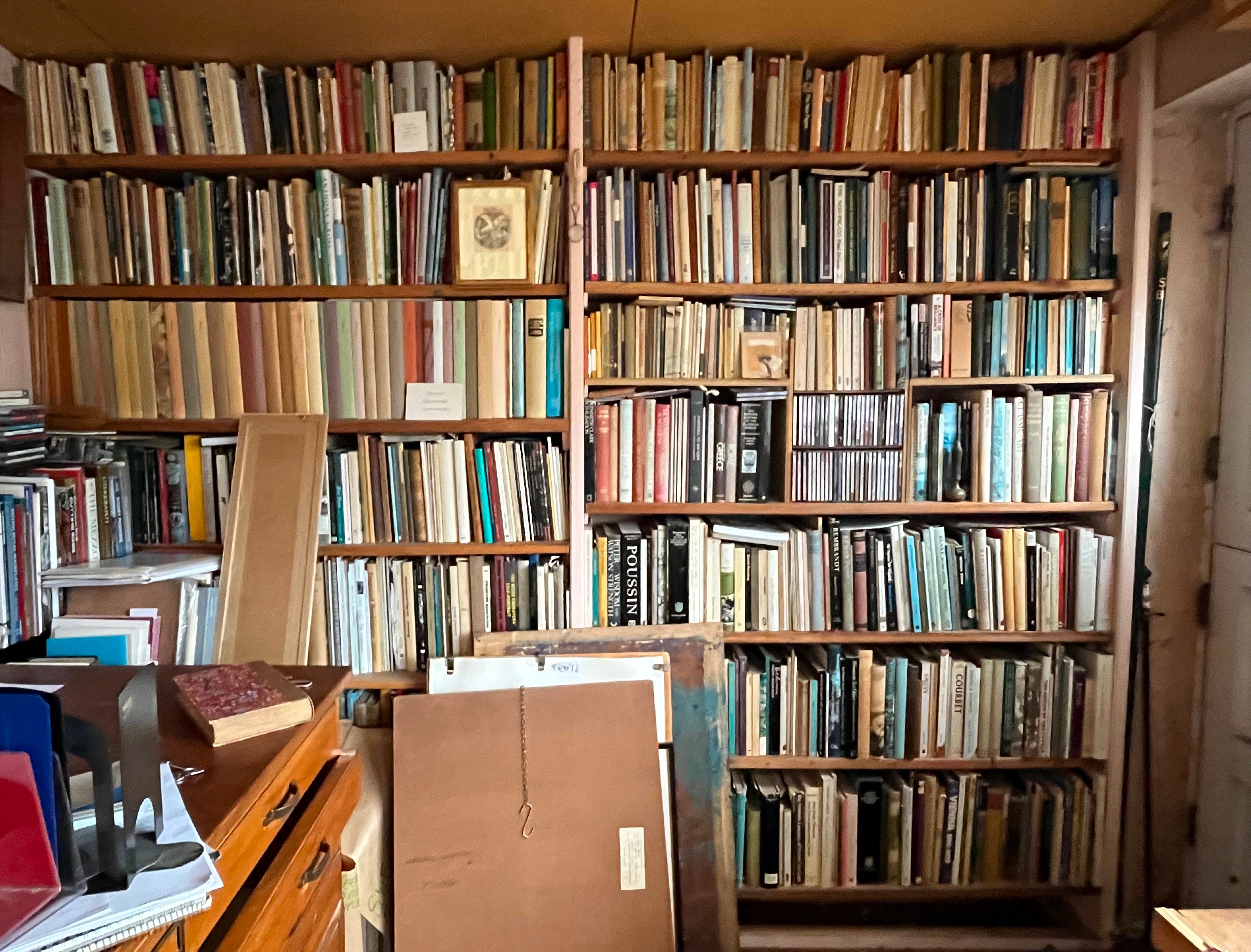
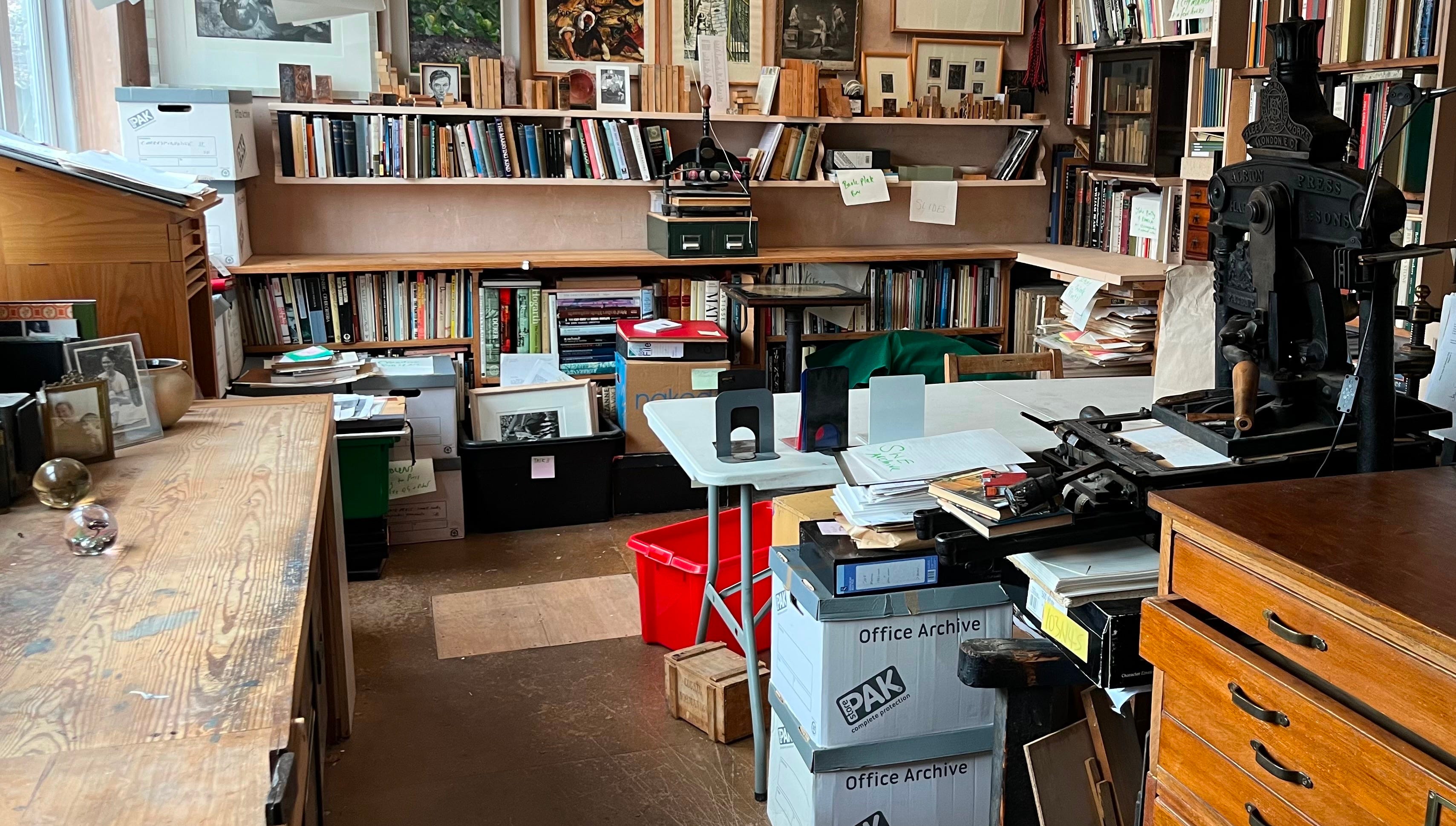
I had a fantasy that we made Simon’s studio, and the house, into a retreat centre for the arts. The log fire, floor to ceiling bookshelves and decades-deep atmosphere of creative stillness are perfect.
There is even extra studio space in the house, the garden has pear and apple trees, vegetables, roses… The air is fine, and the night sky in Wiltshire is often clear and starry, but the town is just a walk away so the retreat centre would not be too cut off. KL and I would manage it, reinstate the piano for sing-songs, and Baby E would grow-up with trails of artists tramping up and down the garden path.
I was attached to this idea, it was unrealistic and I have ditched it. Now I have told you about the fantasy retreat centre, dear reader, it is somehow easier to let go.
The gravel crunches, I park the car outside the studio and wrench the handbrake. After August and September off, I returned for three days. My mother, Juliet, would look after Baby E, now toddling at high speed, humming and rooting through all she encounters, and my husband KL would stay in London with Millie, the spaniel, and our dear friend Nancy, who is staying with us.
After Simon died, an unfinished block was found on his desk; a bookplate of his own with a monogram of his initials (SB). As a wood engraver, he was commissioned to make well over 100 bookplates, and Juliet and I wanted to honour his intention, despite his book collection of thousands and having no idea how we would practically manage.
Simon’s sister, my aunt, Vanessa Brett, oversaw the printing of the bookplate, and Simon’s longtime friend and collaborator, the wood engraver Hilary Paynter, finished cutting the block for us. Together, she and Simon revived the Society of Wood Engravers in the early 1980s and worked closely for years after so we could think of no one better to ask. Then a smaller, finished, block of the same design emerged and we decided to use both.
My October aim was to clear space in the studio for volunteers to stick-in the bookplates. A trestle table was needed for gluing, and surface areas for book-drying.
After dropping Baby E off with Grandma (Juliet), lugging our bags inside, I went straight out to the studio. My archive boxes stood at the far end, where I had left them, and not one clear surface existed. I had left work in progress there (piles!), and so had Vanessa and Juliet.
Over the summer, we had confirmed who would take all the books when we were ready; I imagined the wooden bookshelves bare. Would I learn something of younger Simon? A pencil-written note like a message in a bottle, maybe?
I shifted papers, prints and pamphlets systematically, sorting Simon’s folders of preparatory drawings and proofs, sketchbooks, framed prints; categorising other artists’ work, art equipment, book research notes, correspondence, files to define later, stationery…
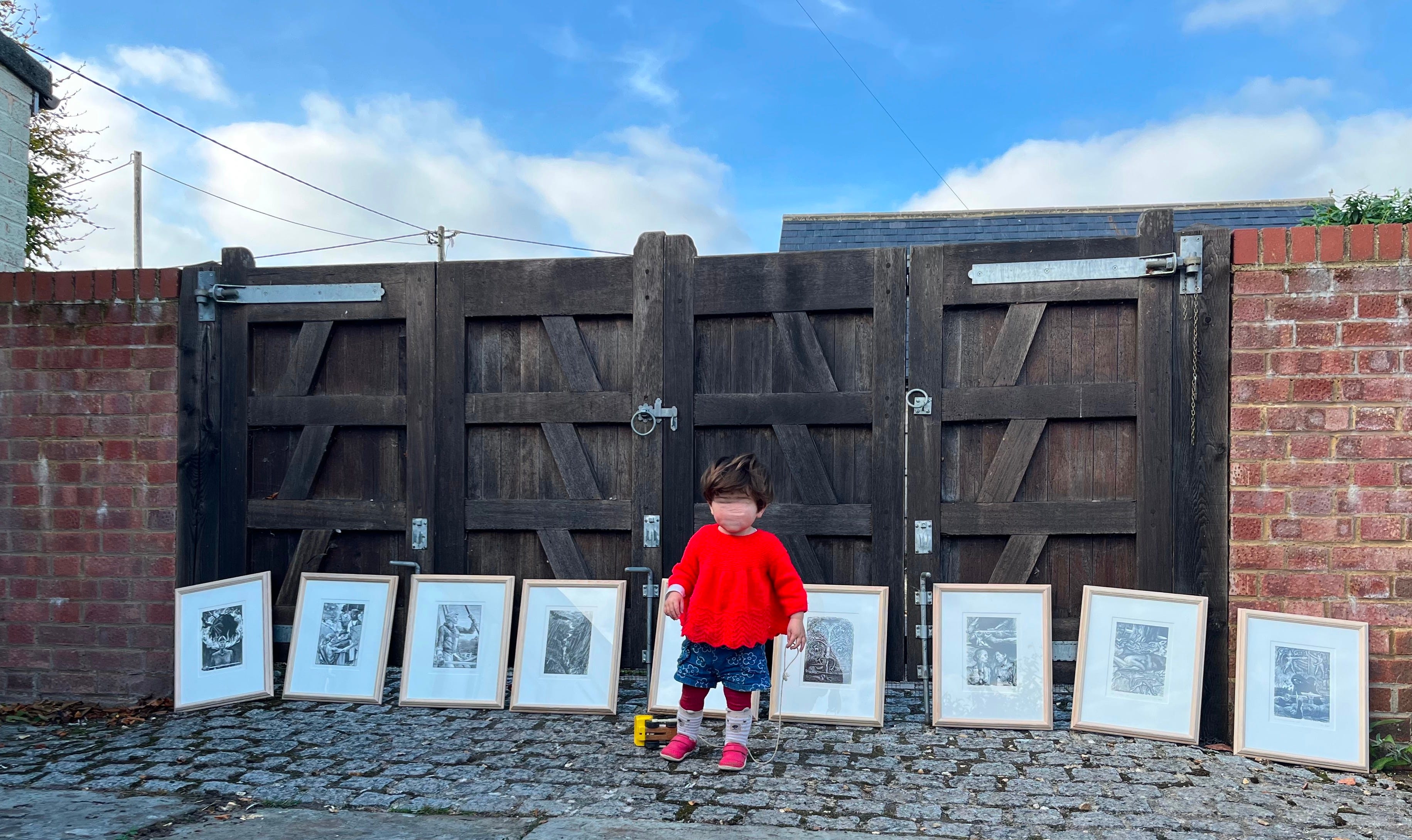
Juliet and I wanted to see the remaining framed prints by daylight, all together, so one day we arranged them outside the studio like a private exhibition.
I found a record book of all Simon’s engravings from 1961 to 1984 — commissioned bookplates and illustrations, and independent works. Each stuck by hand with the date and a one-line descriptor, For, then the client’s name. The SB monogram featured early on, although he may have designed that in childhood. Next to his engraving of me as a baby was written, For love.
When I looked down at his engraving desk, his tools were as he had left them on the green baise. His last block was on the sand bag, his chalk pot with ‘Simon’ written on the lid from art school days, the open sketchbook, pencils, paint brushes. He gave it his all.
In August, KL, Baby E, Millie and I went to the seaside and returned full of breeze. While away, we had building work at home, knocking down a wall between the kitchen and sitting room and laying a new floor. For months before, I had been overstretched and over barbecues in the evening by the sea, KL and I had heart to hearts. As progress was made in the studio, my own life had silted up, and we decided to take September completely off the studio. When I told Juliet, she felt anxious that the necessary work would not get done in time for her to put the house on the market but she understood.
September was spent getting things straight after the building work, except for an escape to the Lancaster Jazz Festival, where one of my friends, Sophy, had volunteered since it began in 2022. I had been dying to go and thought that even if I had to listen outside a door, holding a screaming baby in headphones, it would be worth it. It was Baby E’s first train ride but second small independent jazz fest (!).
Sitting in a dark room one afternoon, a band called Evening in the Universe brought me to tears. Their music was full of joy, they were old souls, and I had never heard anything like it.
After Simon died, I lost my sense of him. He knew so many people, a wonderful thing, but there was so much correspondence, I have still not replied to everyone. I lost his essence and his voice. With the funeral, admin, the studio, I just went numb, and this music reunited us.
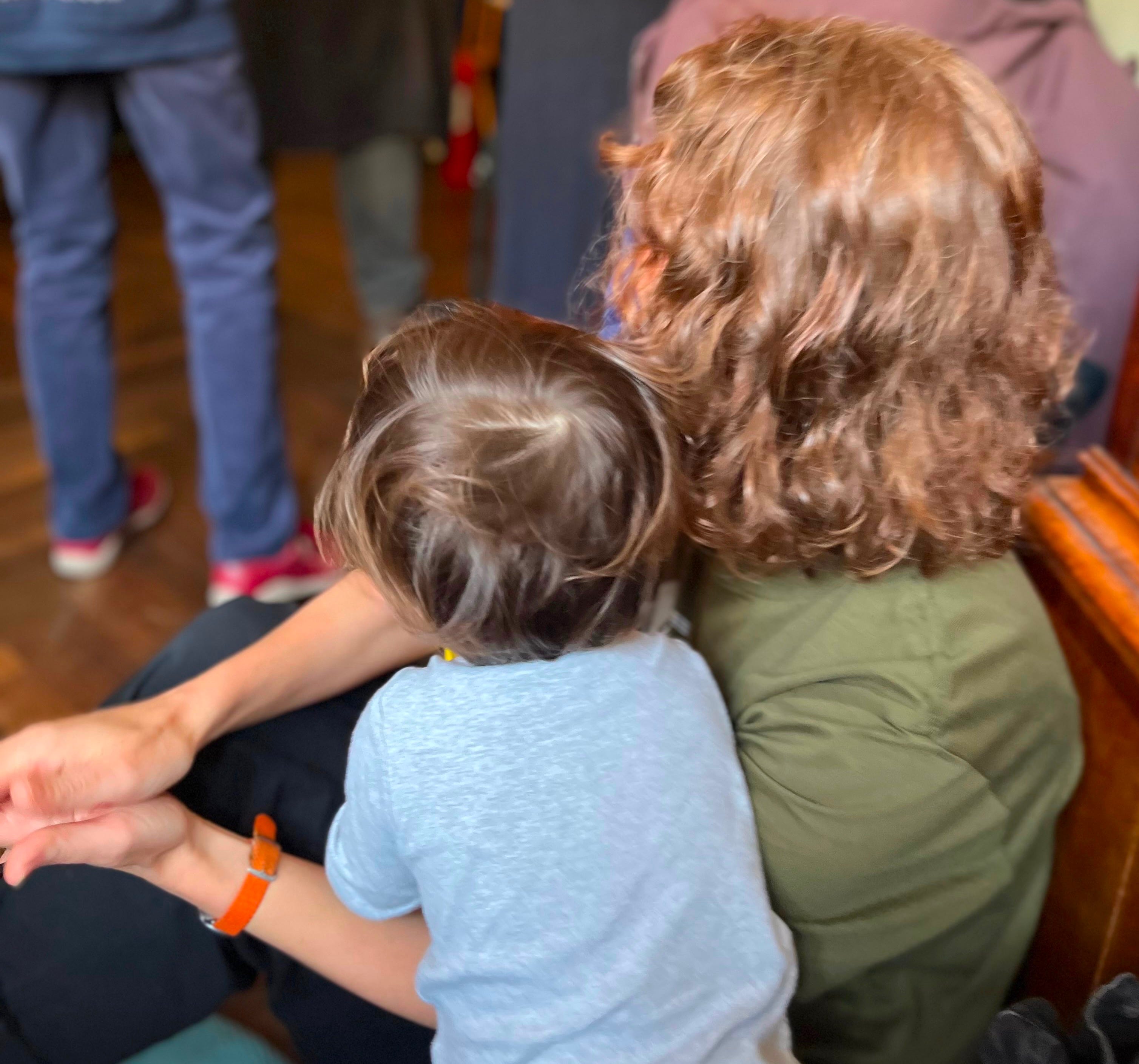
This time, when I unlocked the studio, I felt as if Dad and I were going in together. I was no longer searching for him there.
At his engraving desk, I gathered up his tools, wrapping them in the green baise, moving the chalk pot and closing the sketchbook. I held his last block to my heart and whispered, I will look after you — for love.
Desert Island Discs came on Radio 4 with Ronnie Wood and I turned up the volume and sang along to Howlin’ Wolf, suddenly enjoying myself, having a little dance and remembering how much Simon enjoyed it when people were relaxed and just being themselves, however that was. I got a pang, reminded of how I sing Baby E to sleep (sadly not quite like Howlin’ Wolf…) and hoped she was okay with Grandma.
The bare engraving desk felt a bit much, after all, so I put back some pictures, sketchbooks, sandbags and a magnifying glass.
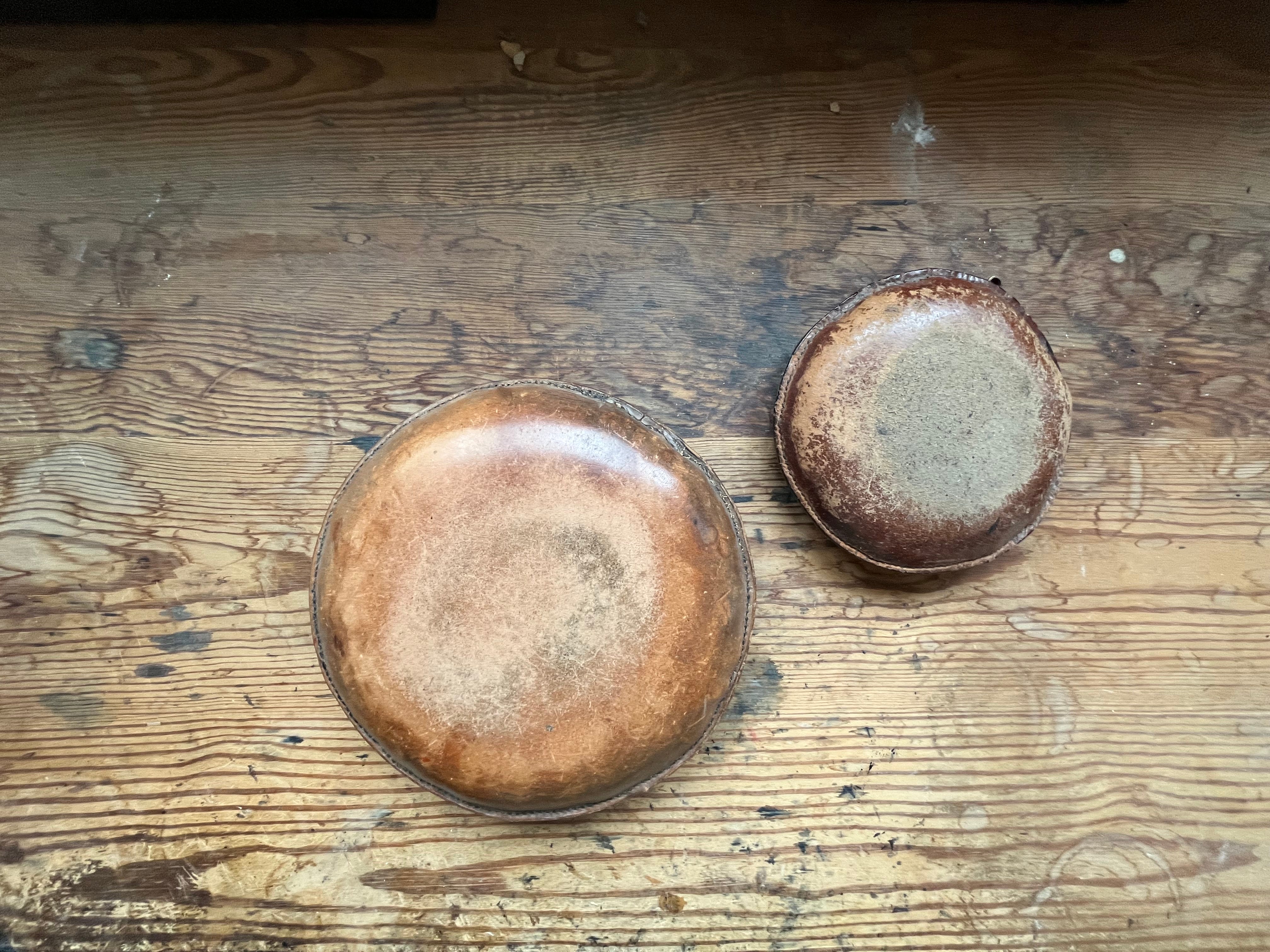
I have not lost a parent before so I am feeling my way. I feel Dad’s presence all the time. Generic as it may sound, I feel he is in peace. I am glad he is out of pain and I miss him. I feel so much for Juliet, I find myself wanting her to know more than ever how loved she is. Her friends and neighbours have been incredible.
At the end of Simon’s life, it was hard when Parkinson’s sometimes took his voice away but I was grateful to be with him in silence. I knew this was the phase before —
One of the things troubling me now is my inability to describe the smell of the books in the studio. When I hold the paper to my nose, I cannot identify the subtle components. They remind me of resting my face against a great old oak in a forest.
During my October days in the studio, I had moments like these:
An orange Kodak envelope contains black and white photographs of hands, holding engraving tools. On the back, Simon’s writing identifies them as Hilary Paynter, Ian Corfe-Stephens, Miriam McGregor and others.
A ring binder reveals a hand-written note from 1973, a year before Juliet and Simon married, when he was teaching at Marlborough College:
‘The act of drawing is a process of thought. One mark after another put on the page of their sequence builds meaning, just as the words of a sentence do. A sequence may rhyme and chime and mean little; it may be nonsense. Likewise drawn marks may look decorative and mean little or be nonesense. But each can also make sense.
Understanding of the higher levels of sense is built on familiarity with the lower levels and the ability to read profound philosophical books is like the ability to look at the most profound drawn and painting statements: it is an acquired, educated skill.’
A brown hardback, LETTERS of the SCATTERED BROTHERHOOD, described on its flypaper as ‘a revelation to those in search of spiritual strength’ is inscribed, ‘Simon from Doll and Little Reggie, Xmas 1967’.
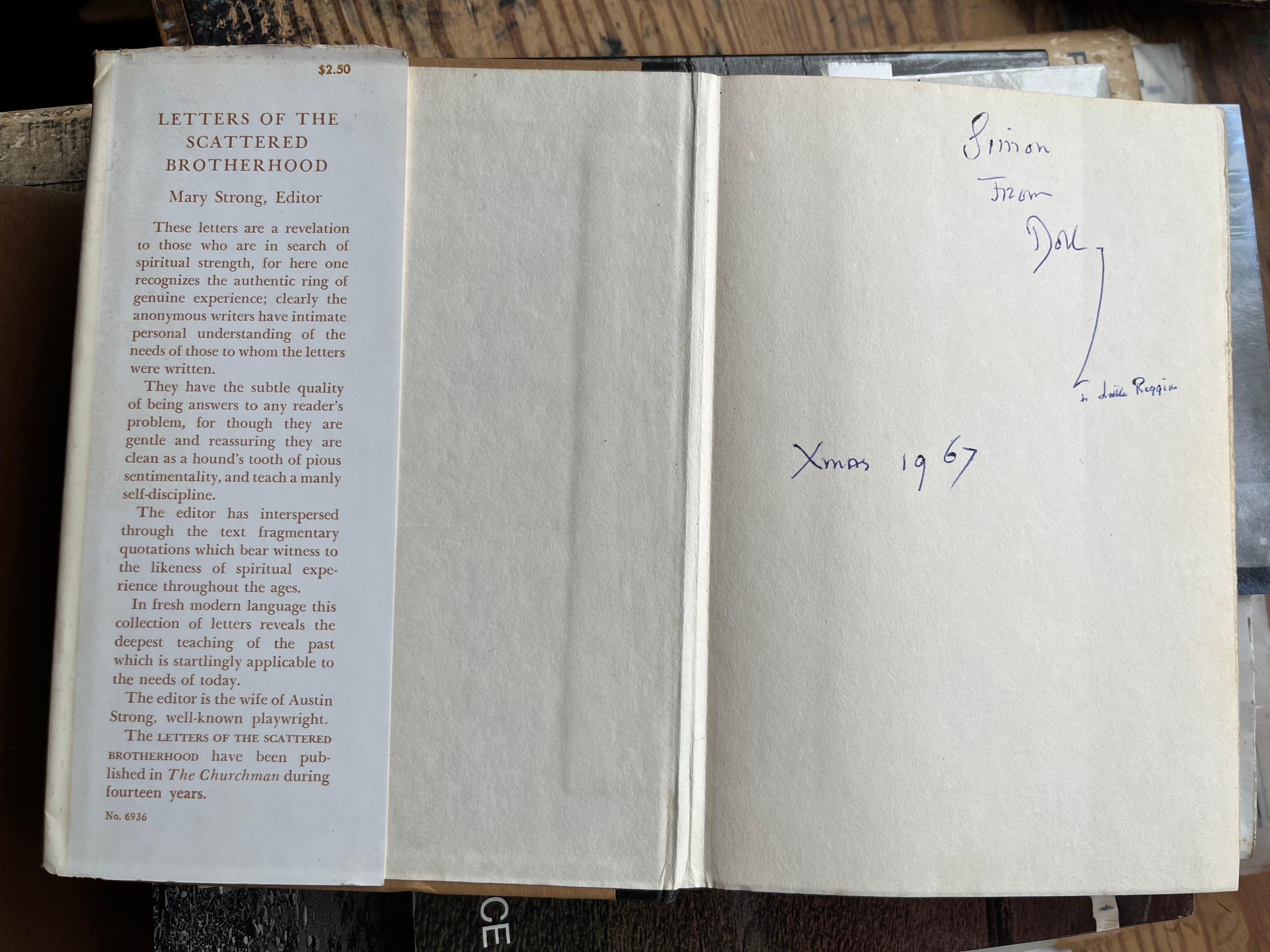
I glanced up at Doll’s engraved image in the print rack. Simon’s last series was portraits of those who shaped his heart (his words). I will never know if he read this book, unless he has written about it. Many have now told me, in their different ways, how Simon’s work has given them spiritual strength.
Long after the studio is emptied, repurposed, maybe knocked-down, its contents will exist elsewhere in the world, which I wrote about in The line starts here. This idea reminded me of Robert Smithson’s Spiral Jetty and, while shifting boxes, I thought of it again. A moment later, I came across Some notes on the work of Richard Long by Michael Compton and it fell open at these words:
‘The line itself was made by walking, as the tracks clearly show… All of Long’s pieces declare their means of making. The line is a spiral, a configuration that is centripetal but has a beginning and an end.’
I like synchronicity and take it as a sign to continue. In Maidens of the Court, where you can see inside one of Simon’s sketchbooks, I touched on the Grail. If we imagine the Grail scattered through our world then we could say that synchronicity is when we encounter the Grail. For example, walking into that music by Evening in the Universe.
I hauled boxes of recycling out of the studio, drawing boards to give to my old secondary school, and my brother Justin stopped by. He had made a database to catalogue Simon’s remaining prints; another project my aunt Vanessa has taken on.
I tried to work simply to make progress, make less work for later, list future tasks and make space.
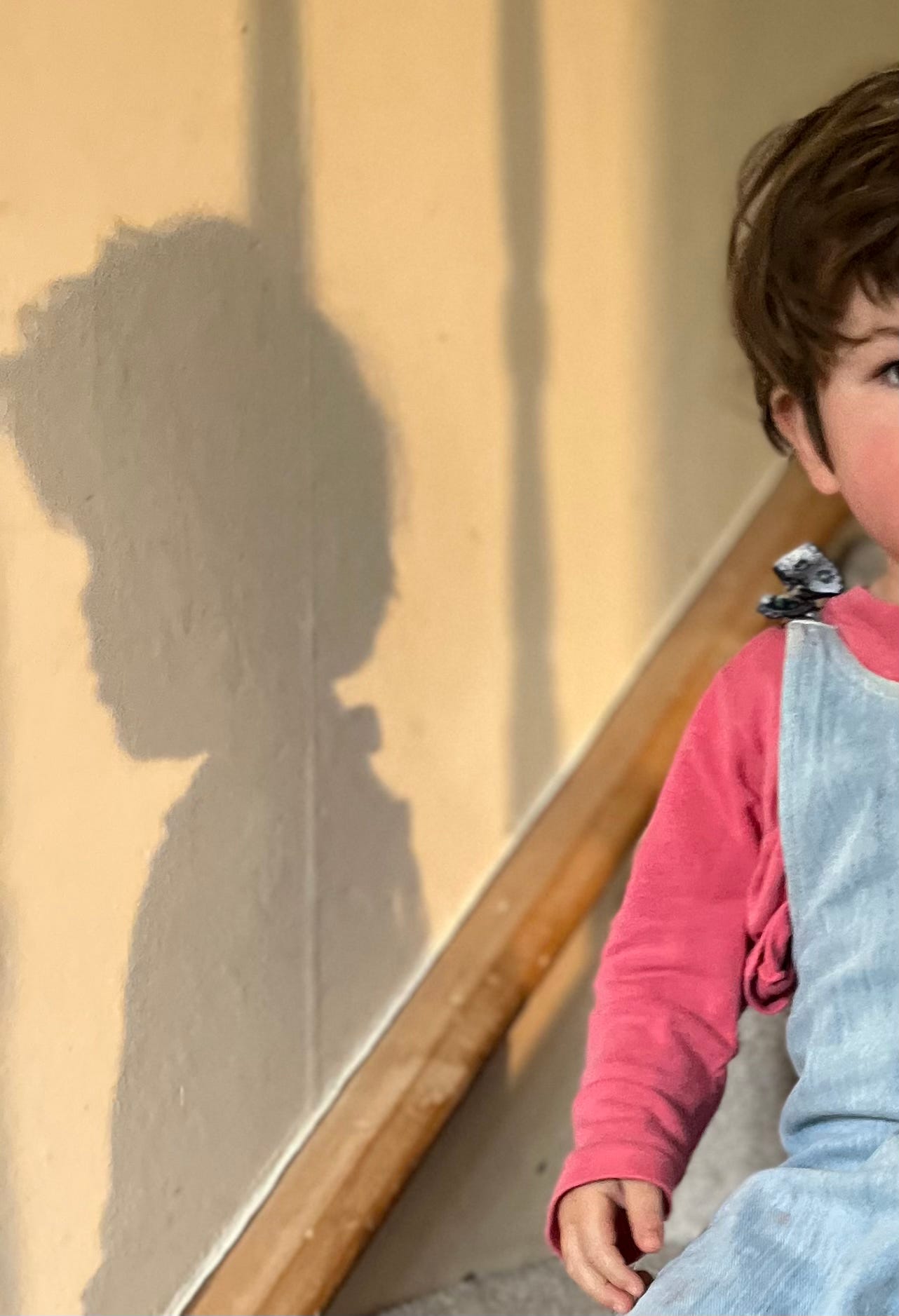
On the last day, I opened the door and Baby E was toddling up the path, parting wildflowers with her hands, Grandma just behind. Baby E was wearing light denim overalls, with ribbon ties at the shoulders, which Juliet made for me when I was tiny on her Singer sewing machine, still used for adjustments, in the not-artist-retreat-house. The garden is also down to Juliet too.
I squatted down and Baby E rushed into my arms. Juliet looked relaxed and happy when I showed her the clear surfaces and trestle table.
The car boot was heavy with Simon’s Sight & Sound magazine collection, which I was taking back to London to put on Freecycle, as we pulled off this time, and Juliet was in the front passenger seat. She was coming to stay, via the studio of Phil Smythe, new owner of Simon’s large Hopkinson & Cope Albion press, who had invited us to lunch, and to see the press in his studio, which meant a lot.
Juliet also had a bag of blocks for Chris Daunt to resurface, which Phil said he would give him next time he went on a course with him. Chris is a blockmaker, wood engraver, teacher of wood engraving and was dear to Simon.
The roads to Phil’s house were new to us. We spotted a duck pond and a particularly yellow tree. Baby E sang in the back, and Juliet told me about a portrait she once painted nearby. As we drove through autumn, I realised that Simon’s studio would always be with me, wherever I went.
I was looking forward to showing Juliet our new open plan kitchen-sitting room. I could still see Simon engraving at the sitting room desk after Christmas, two days before his death. Now there would be more space and light for all of us, with a through-breeze when the windows were open.
If you enjoyed this, please could you spread the word? I am building-up my writing here at The Line, while being a mum to Baby E, getting back to life after breast cancer and dismantling Simon’s studio. Thank you so much.
From my part of the line to yours, thank you for being here too.