

Hello. This is a post about lines.
I don’t know if you are familiar with The Wasteland by T. S. Eliot but April always reminds me of the first line, which begins:
‘April is the cruellest month, breeding
Lilacs out of the dead land…’
Now that May lies like a deep moat between April and June, I am ready to write about it. April was not the cruellest but it was hard and memory, desire and dull roots stirred in the dead land where the lilac grew. Dad (Simon) was everywhere, just out of reach.
By the time I had finished my two week stint in the studio with Nancy, I was desperate to go home and as I drove out of town, the road shone with spring rain and as I reached the forest, hot sun emerged and light shafts scattered through the dripping trees.
Even driving then, I had a weird sensation of being transparent, which was how it had felt for the past days, as if the studio had bleached me so I had no outline. Even though I could see the glistening emerald forest, I only felt anger.
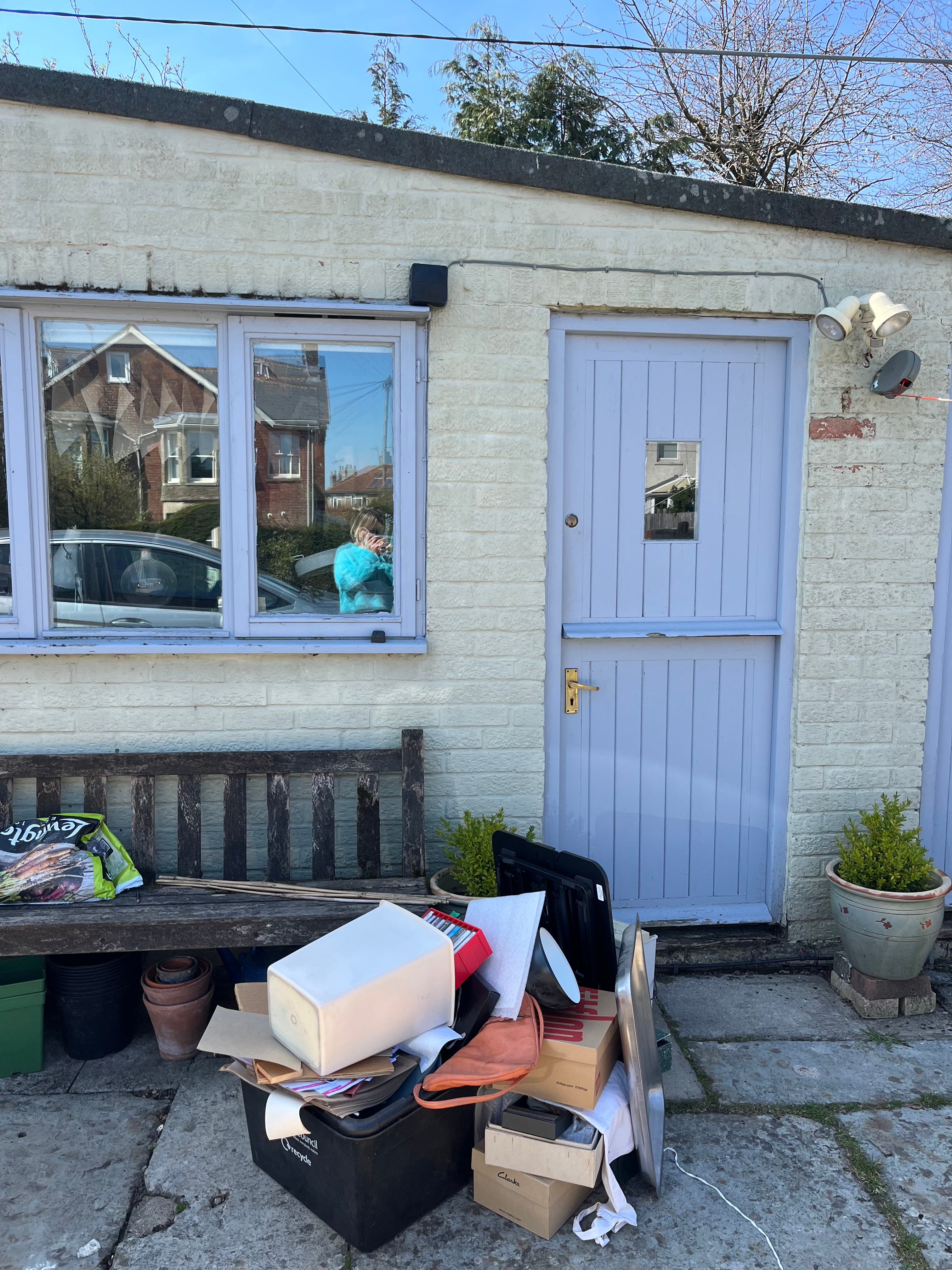
Before I left, outside Juliet’s house, I had stuffed the boot full of the last two weeks’ clothes for Baby E and me, an old cardboard Easter egg Juliet no longer wanted at hers, bottles, the steriliser… We had hugged and as I drove down the hill, I could see her waving in the rear view mirror. It still felt strange that Simon was not there too.
Last time, I wrote about living the questions rather than hunting for answers and one of my central questions now is what I am comfortable sharing — from Simon’s studio, in what will be his public archive, and in my own writing.
Since Juliet told me on the phone that he had died, I have felt him close. In the days following his death and at his funeral, the quality of air and light was fine and bright and on the days I have been working in his studio, even on the coldest and darkest, that light has always appeared suddenly and I’ve had to swallow back tears.
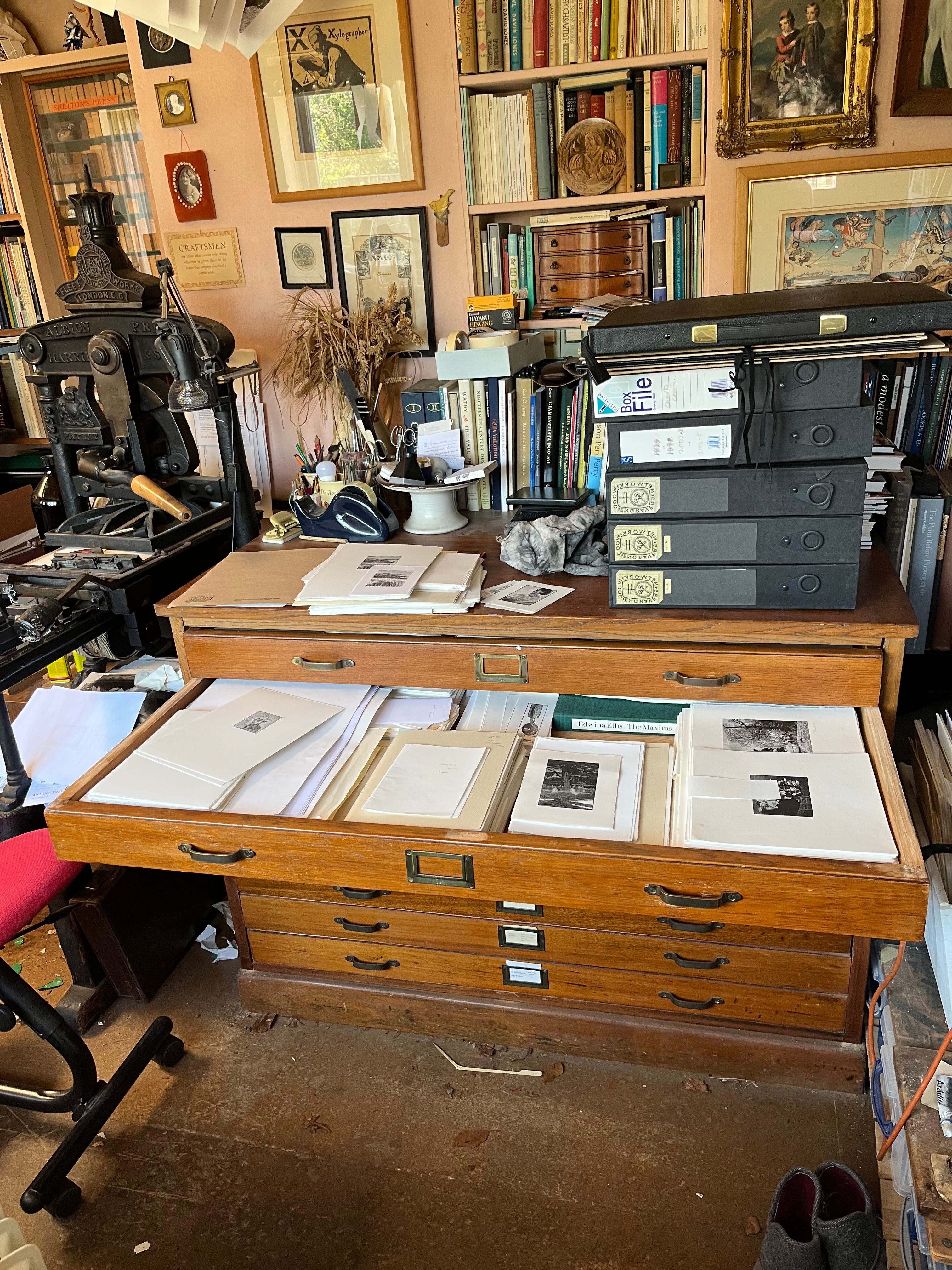
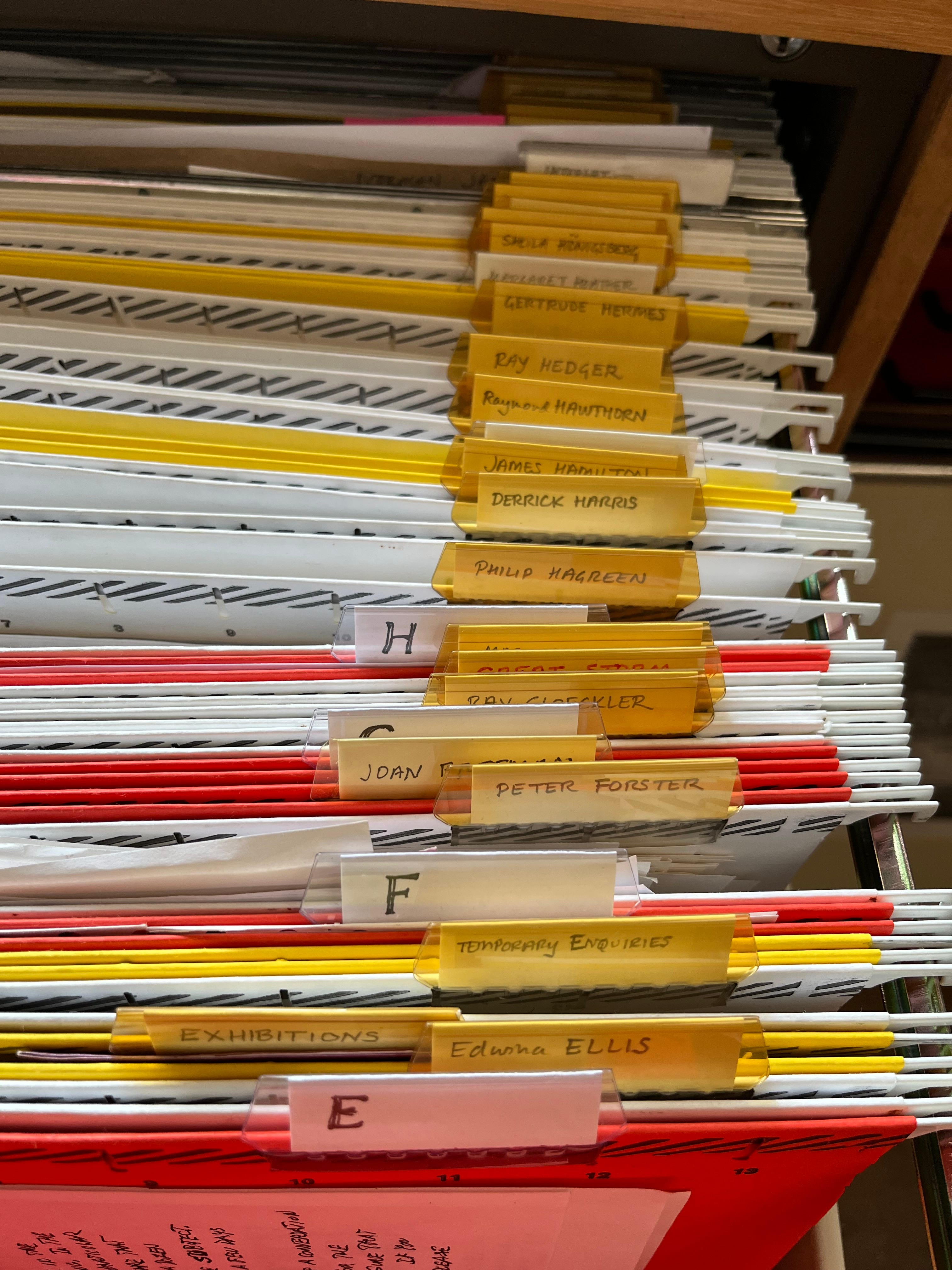
Nancy and I spent hours together there in April. Piles of prints and books sat on the work surfaces with archive boxes on the floor, labelled in black marker pen as we worked quietly. She sorted through papers and prints, identifying what was what, on a drawing board Simon had laid on the old Hopkinson & Cope press while I worked from one side of the studio to the other, looking in every drawer and folder, flicking through notebooks, so we knew where everything was. It was like putting a glass up to the wall of the past, listening as for a heart beat. The hardest part was not knowing where in time he would speak from.
At one point, Nancy was carrying a box down the garden path to the house so I was alone. I picked up a notebook from his engraving desk and it turned out to be a diary. The sentence I read was so personal, I shut it quickly, jolted by the ardor of his younger voice and a sense of having trespassed.
It was far from sensational but it was private, a free-flow of thoughts and emotion from years ago. Through writing, as I do sometimes, he was clarifying what he thought and how he felt, and I suddenly felt very protective over him. I did not want anyone else reading his diaries, including me, but unless I did then how would I know whether I felt okay with making them public?
In a moment, my peace switched to anger and I felt as if I was subjugating my life to the endless task of dismantling Simon’s studio. What with also being a new-ish mum and supporting Juliet with probate, I did not have much spare time and the time I did have, I wanted to spend with my beloved KL, who incidentally is recovering (well) from a stroke, which affects the whole family as our brilliant NHS team says.
Alone in the studio, I have told Simon I love him, that it is my honour to handle his studio and artistic estate and also that I am really angry, and I am so tired and fed up with the number of decisions that have to be made. I understand they cannot and should not all be approached at once but when my brain starts to steam, I am grateful for my meditation practice and idioms such as ‘let’s kick the can down the road’.
The issue was that Juliet wanted to move house but the studio needed to be empty for her to do so. If you have not seen through the door of the studio, you can do so here. She told me that the multifarious tasks of clearing the studio could not be rushed and that this was the most important thing but her heavy heart and face said otherwise.
As her daughter, over the years, I have found her consistent habit of putting others’ needs above her own annoying. I have seen her give so much to support Simon’s work, alongside her own successful career as a painter, and I found the idea that his studio would now stop her moving intolerable. If I took the slow approach, she would also be dead before it was finished and I wanted her to at least have the option of having her new chapter, of course carrying Simon in her heart.
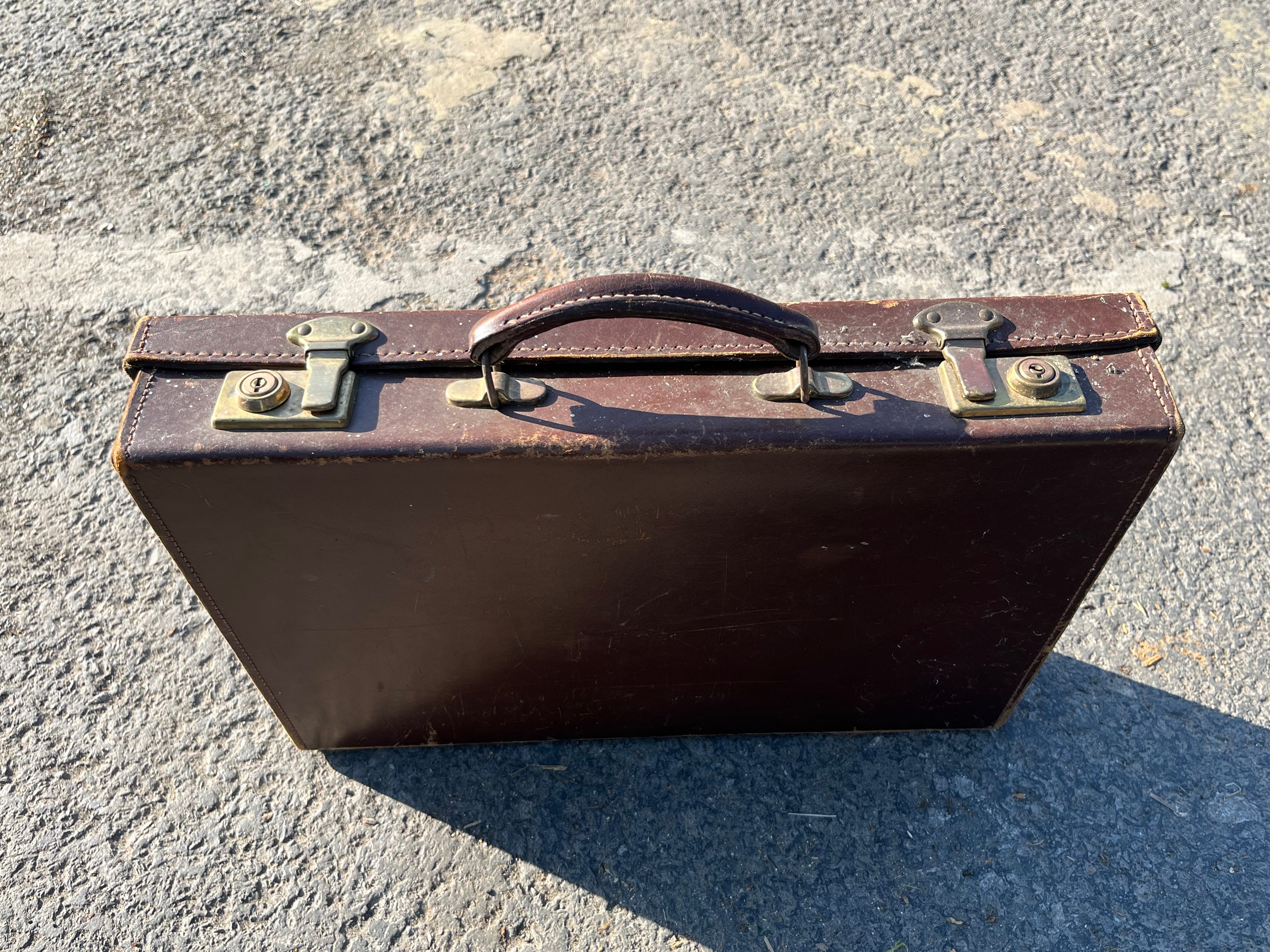
I took a deep breath. His old brown leather brief case rested against the plan chest, in which he used to carry slides and lecture notes to Marlborough College, where he taught Art. As a child, sometimes I would go with him, walking down the hill holding his hand, skipping alongside his purposeful strides.
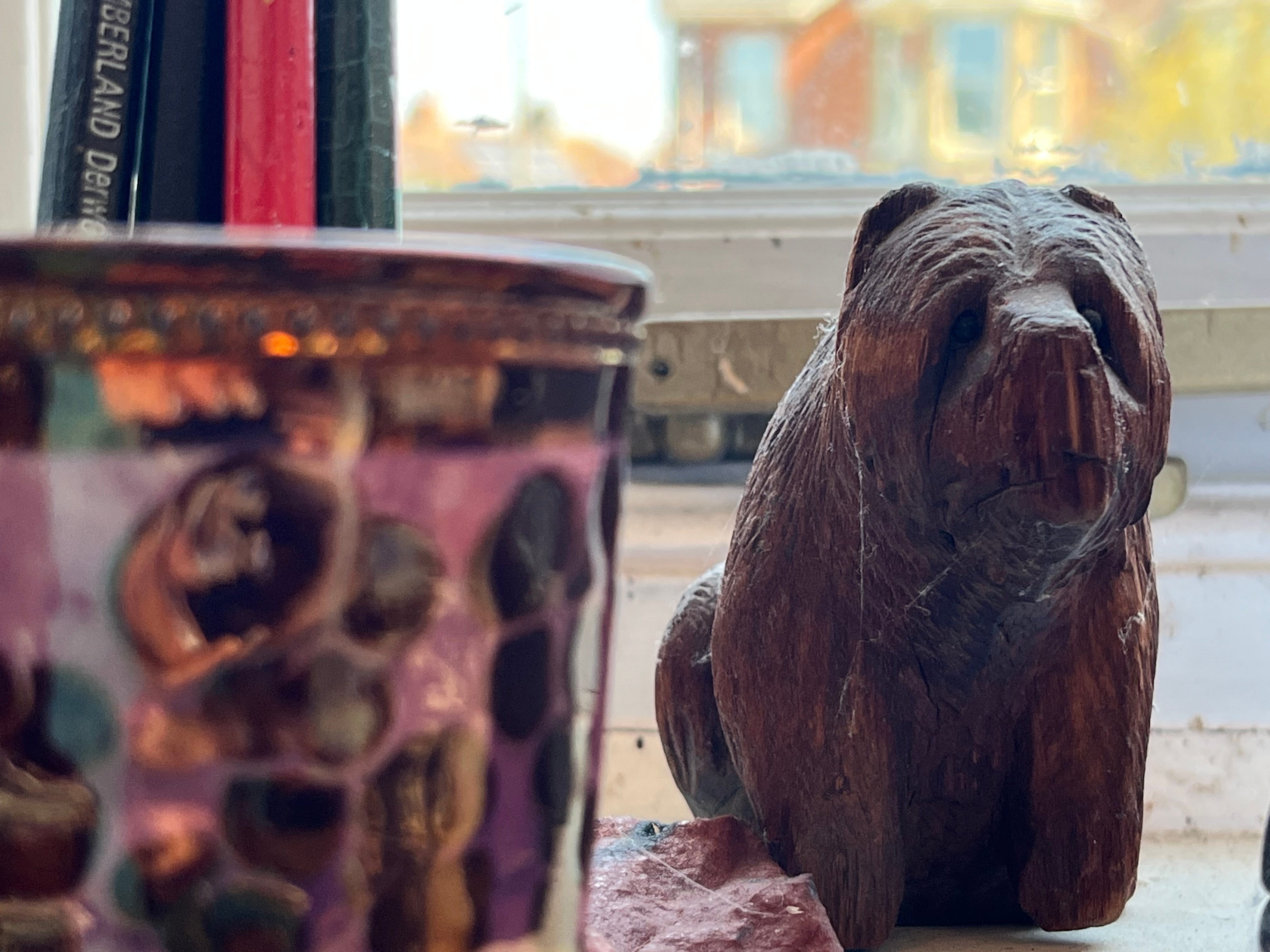
His finger prints were everywhere, from the brief case handle to the little wooden bear on the shelf, saved from his own childhood, to his engraving tools to the lilac line that shows what he did that morning, before he went to his last lunch.
Standing there, looking at the notebook, I realised there were no boundaries in the studio and I found that deeply unsettling. The topography does not reveal what is below the surface.
I used to love being with Simon in silence, the quality of depth and presence and then the words that emerged. But it is different now. I can read his words on paper or the computer, most of which were written for others, and I can respond but the silence afterwards is different. It is a silence of absence.
As I watched Nancy absorbed in concentration, looking at a print then putting it to one side, I felt our own depth, which has no sides and words are only needed when they are there. Out of everything she could have been doing, she was with me and we were together in the experience. I caught her eye, smiled and we carried on.
Between us, we listed the titles of all the prints in the plan chest with its eight deep wide drawers. I finalised my list of categories, some of which together will constitute his archive. The others, such as the presses, books and art equipment will find new homes and make the not-Spiral Jetty but the new pattern of Simon Brett’s studio in the world, which I wrote about here.
I finalised the press adverts, drafted a plan to enable more delegation in the summer and boxed up Society of Wood Engravers (SWE) historical materials, which would be be couriered to Special Collections Museum at Manchester Metropolitan University, home of the SWE archive.
We attacked the attic space above Juliet’s room, bringing heavy dusty boxes down the ladder past the double bed and into the hall: boxes of beautiful old SWE publications (destination current SWE Chair). We found the only remaining books from Simon’s Paulinus Press imprint he ran in the 1980s and copies of the many Folio Society books he illustrated.
As we worked, lilac slowly pushed down its roots and grew all through the studio and Juliet and Simon’s house of books and pictures and the living and the dead were together.
As Juliet decluttered, she minded Baby E, who was learning to stand and could often be found in a corner, stoically gripping a chair edge, trying to look as if she meant to be there but actually just not having worked out how to get down.
Jeremy Parrat, senior curator of Manchester’s Special Collections Museum, had kindly advised me that our family might like to make sure nothing sensitive lay in Simon’s files before sending them out into the world. As a life-long Dostoyevsky and Eastenders fan, my ears pricked-up at the hint of drama but he calmly explained he just meant anything really personal like a letter that we may want to keep back for ourselves.
And so Nancy looked through every single packed suspension file in the filing cabinets and through Simon’s fine press book collection, just in case a letter had been tucked between the pages.
Nancy and I lit a candle in honour of Simon and filmed it impromptu, which you can watch here. Over breakfast once, she read me some of the introduction to Tim Ingold’s book, Lines: A Brief History. More on that another time but for now just to say it is very different from Eliot’s The Wasteland, from which you may recognise April’s lilac, memory, desire and stirring roots, but perhaps the writers’ pens dipped their nibs in the same ink.
We took car loads to the recycling centre, both of us grubby and tired, climbing the metal steps to tip out boxes of paper, small electronics and large goods into the vast cast iron skips.
The morning after I dropped her at the bus station, I tidied the studio so it would be in a state I was glad to come back to. I realised Baby E had been quiet for a bit too long and found her sitting by the door next to an overturned shredder, carefully picking up each individual strip of paper and making her own little pile.
As I carried her down the garden path, the blousy pink tulips had their faces turned to the light. I wondered how many more times I would walk down that path before it was someone else’s house.
I left Baby E with Juliet and took a last car load of stuff to the recycling centre, including the brief case. The hot sun made it look like a scene from a holiday park, everyone happily getting rid of their stuff, lilic growing through the chain link fence.
I got the brief case out of the boot, walked towards the larger objects skip, thought I can’t do this then came back to the car and hoped no one would notice I was crying. I put it on the ground at a distance and took a deep breath. Suddenly, I realised I could not see my shadow. It must be because I am transparent, I thought to myself and then the spring rain started. Before I let it go, I held it to me close
Through the emerald forest and out the other side, the fields were bright and Baby E was breathing peacefully. Juliet has recently changed her plans so the intense pressure is off but onward ho, as Simon used to say.
From my part of the line to yours, thank you for being here too.
[And, if you heard any crying in the background of today’s recording, today is the day after Baby E’s christening and she is feeling the after effects of all the sandwiches and excitement. Juliet is looking after her very kindly downstairs while I finally record this.]


